


Harmonious Learning
June Asked, How Does a Solar Eclipse Happen?
June Asked, How Does a Solar Eclipse Happen?
Couldn't load pickup availability
Dimensions
Dimensions
11 in x 8.5 in
Age Ranges
Age Ranges
0-10 years
What's Included
What's Included
Dialogue, Illustrations, Scientific research,Dictionary, References, Family Bonding
Book Description
Book Description
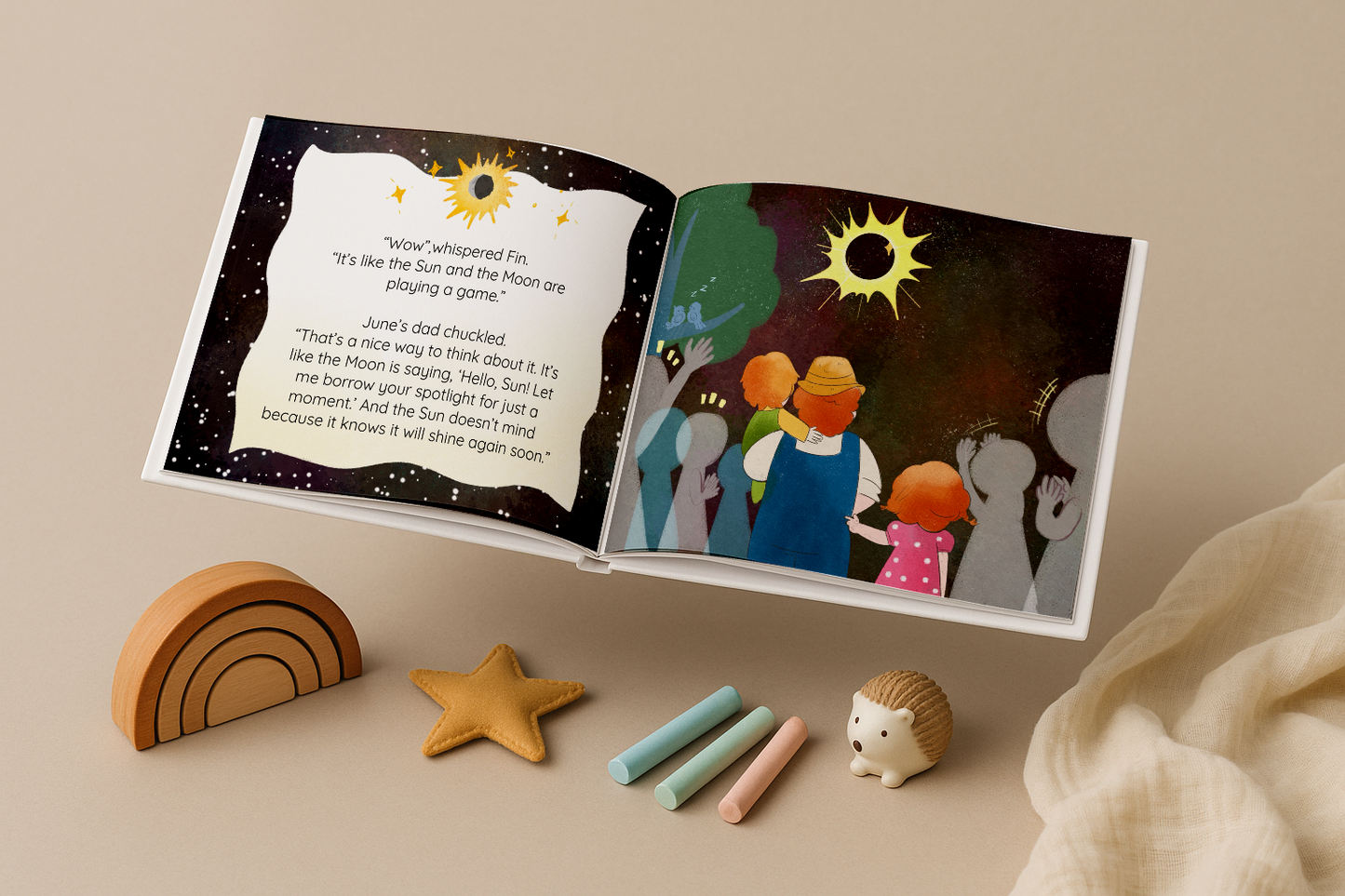
One minute June is running and laughing with her friends under the bright blue sky… the next, the sun starts disappearing! The sky turns strange, the shadows get scary, and everyone on the playground gasps.
“Why is it getting dark?”
“Did a storm sneak in?”
“Where did the sun go?”
Luckily, June’s dad knows exactly what’s going on, and he’s got the coolest story to tell. Using simple words, he shows everyone how the sun, moon, and Earth sometimes line up perfectly in a way that leads to a solar eclipse.
But how does a little moon hide the big, bright sun… and why does it only happen sometimes?


June Asked
Curiosity - the deep desire to wonder, explore, and understand, lies at the heart of how children learn.
It’s the spirit behind every wide-eyed question:
“Why?” “What is it?” “What can it do?” “What can I do with it?” “Why does it happen?” “When does it happen?....” “How does it happen?” “What happens if…?”
This natural urge to investigate is powerful, and it’s what fuels a child’s early learning journey. That’s why it's so important to nurture it. As a parent, you have a unique opportunity to spark and expand your child’s curiosity by offering them irresistible invitations to learn: open-ended resources, playful questions, and everyday moments that lead to discovery.
But as children grow, especially beyond the early years, this curiosity often begins to decline. Not because it’s no longer there, but because the environments around them, including traditional schools, don’t always make space for it. Standardized curricula and content-heavy classrooms can leave little room for exploration or inquiry. Our education system doesn’t require children to be too curious, instead prioritizing a defined curriculum content and standardization. That’s why it’s critical to protect and feed your child’s natural curiosity now, while it’s still burning bright.
Think about your child blowing bubbles into their milk for the first time. You might see a mess in the making. But your child? They’ve made a discovery. They’ve learned that air plus milk equals bubbles.
And with that discovery comes the next logical step:
“What happens if I blow harder?”
Bigger bubbles. A bigger mess. But also, bigger learning.
And this is how children learn best: by doing, asking, wondering, and trying.
It’s this innate human capacity for wonder that drives us to grow, to create, and to discover. The joy of finding something new. The spark of creativity. The thrill of figuring it out.
Your child’s curiosity is not just cute, it’s powerful. It’s the engine of learning, creativity, and lifelong discovery. And the best thing you can do? Keep that engine running. The tools you offer, the books they read, the conversations you have, and the freedom to explore can make all the difference.
That’s where this book comes in. In this story, June Asked: How Does a Solar Eclipse Happen? That’s exactly what curiosity looks like in action.
While playing outside with her friends, June notices the sunlight starting to fade. The air cools. The shadows shift. The world suddenly feels quiet.
And then, wow! The sun begins to disappear!
“What’s happening?!” June shields her eyes and stares up in amazement. “How can the little moon cover the big, bright sun?”
In June Asked, How Does a Solar Eclipse Happen? young readers join a curious and clever girl as she experiences a real-life cosmic event for the first time, and asks the exact questions kids love to ask.
“Why is it getting dark during the day?”
“What’s a solar eclipse?”
“How can the tiny moon block out the massive sun?
With the help of her dad, June begins to unravel the mystery, learning about the Earth, the moon, the sun, and how their movements align just right to create something amazing in the sky.
Through playful dialogue, beautiful illustrations, and kid-friendly science, this book helps children:
· Understand what a solar eclipse is and how it works
· Learn about the ever-changing position of the moon
· Feel empowered to ask questions, observe nature, and love learning
Perfect for ages 0-10, this book turns one girl’s wonder into a fun, educational adventure that inspires children to look up, think big, and look at the universe with fresh eyes.
Research Result
A Quiet Revolution in Learning
Imagine this:
It’s quiet. You sit beside your child, your voice soft, the lights dim. A story begins. And in that magical moment, something extraordinary sparks within your child’s brain.
Neurons are firing. Emotions are calming. Vocabulary is expanding. And deep, lasting learning is beginning to take root. This isn’t just a bedtime ritual. This is neuroscience in action, and it is life-changing.
Reading to a child may seem simple, but it is profoundly powerful. Children naturally love books; they touch them, flip through pages, study the pictures, and listen intently to your voice. That’s because every child is born with a boundless imagination. And imagination is where innovation begins. It allows children to visualize things they’ve never seen, building the creative thinking that will carry them into adulthood.
In an increasingly digital world, one thing hasn’t changed: face-to-face storytelling remains one of the most important tools for nurturing a child’s imagination. And it’s not just the act of reading; it’s the content of the stories that matters.
Studies from Stanford University and journals like Developmental Science confirm that early exposure to numeracy, science, and problem-solving concepts leads to stronger school performance and sharper reasoning. Children who hear “math talk” or “science talk” early on are more likely to pursue and excel in STEM fields later in life.
So, what happens when we move beyond casual conversation and introduce academic concepts through enchanting bedtime stories?
The answer: something remarkable.
Academic bedtime stories, those that gently introduce math, science, art, and language, build mental frameworks, or “schemas,” that help children organize and retain knowledge. Unlike raw instruction, a narrative arc makes abstract ideas easier to understand.
For instance:
● A story like “Ethan and the Trains: The Magic of Multiplication” can build early number sense.
● A tale like “June Asks: How Does a Solar Eclipse Happen?” fosters scientific inquiry and wonder.
How Academic Stories Grow the Brain
Bedtime stories that integrate academic content, math, science, art, and language offer greater cognitive gains than general stories. And academic stories aren’t just about words; they light up a child’s imagination, helping them visualize and think creatively. This mental exercise is like a brain workout, strengthening cognitive skills that children will rely on for years to come.
Stories that combine education with imagination create a sort of brain workout. They spark critical thinking, build vocabulary, and improve focus, all while reducing stress. This process also enhances neuroplasticity, the brain’s ability to form new neural pathways. When your child hears a calm story about the moon, their brain isn’t just entertained, it’s growing.
And bedtime is the perfect time. Neuroscience shows that what a child learns just before sleep is more likely to be stored in long-term memory. Concepts presented through stories during these moments are encoded more deeply during sleep cycles, especially during slow-wave sleep. This has been demonstrated across vocabulary, math facts, and science knowledge in early learners.
Reading academic bedtime stories to your child activates the parts of the brain responsible for language and comprehension. When you read, you’re helping them build neural pathways that support learning and memory. Studies show that children who are read to regularly have vocabularies 30% larger than children who aren’t read to at all. This also helps lay the neural foundations for future academic success.
By age five, a child’s brain is 90% of its adult size. But brain development isn’t just about size; it’s about forming the right connections. During early childhood, the brain forms more than 1 million new synapses per second. These connections lay the groundwork for everything: memory, emotion, learning, and reasoning.
This is the most fertile window of brain development, and the experiences a child has during this time literally shape their lifelong ability to learn, adapt, and thrive. The young brain is incredibly plastic; it’s wired to adapt, absorb, and grow based on experience. So, when you read stories that include early math or science in a playful, age-appropriate way, you’re not just reading. You’re building brain pathways for lifelong learning.
Early Exposure is Strategic, and this is Powerful
This is why starting early is important. This is the power of academic bedtime stories. And it’s why our books aren’t just books, they’re brain-boosting tools to help raise curious, capable, and confident learners. So yes, bedtime stories are sweet. But with the right academic content, they’re also strategic. That’s because, as children are introduced to rich academic content early, especially through joyful, meaningful books, their brains do more than enjoy the story. They get to work. Because the young brain is so plastic, it quickly stores this information in long-term memory. And once wired, these concepts stay, forming a strong framework for future learning.
Every time you read a story that introduces numbers, patterns, cause and effect, nature, or discovery, you’re giving your child a head start. You’re not just teaching facts, you’re training their brain to think, connect, and crave learning. This is supported by robust research. Studies from Stanford and the University of Chicago show that early exposure to even simple forms of math or science talk improves reasoning, problem-solving, and academic outcomes. When that learning happens through engaging storytelling, children are more likely to retain it, and more importantly, associate learning with delight and curiosity.
That’s why the stories we tell matter so deeply.
We designed our stories with this neuroscience in mind. Our books are crafted to align with your child’s developmental stages, blending big academic ideas with wonder, imagination, and emotional connection. From learning how plants grow to understanding electricity and the heart, each story turns complex concepts into magical, memorable adventures.
Because when learning happens during the brain’s peak years of flexibility, it doesn’t just fill the mind, it shapes the mind.
As the brain matures, it becomes less adaptable. That’s why early childhood is a golden period, when enrichment has an outsized effect. Waiting until later means missing a critical chance to influence how a child learns and sees the world.
While most children’s books stick to the basics, we go further. Our stories introduce foundational ideas in:
● Science
● Technology
● Psychology
● History
● Geography
● Health
● Economics
All in a way that’s fun, safe, and age-appropriate.
Because here’s the truth: children are ready for much more than we give them credit for. When they’re introduced to meaningful content early, they don’t just memorize facts; they build lasting mental structures that prepare them for future learning.
But We Don’t Lecture, We Storytell
Kids are still kids. That’s why we don’t preach. We play.
Our stories feature lovable characters, cozy narration, and colorful illustrations. Each book combines engaging storytelling with built-in learning moments. We’ve woven academic content into cozy, delightful tales that make kids ask for “just one more.” This is learning through laughter. Through wonder. Through characters they adore and adventures they’ll want to relive every night.
Children don’t even realize they’re absorbing academic content because they’re simply having fun.
Each story encourages:
● Critical thinking
● Emotional connection
● Problem-solving
● Language growth
And because they’re interactive, children are drawn into the action, engaging with characters, asking questions, and making sense of what they hear. This deeper engagement boosts comprehension and memory.
Neuroscience-Backed Learning Principles
We built our books around three core principles, grounded in science:
1. Fact + Fantasy = Lasting Learning
● Stories stick.
● Characters help children emotionally connect with ideas.
● A bedtime tale about “how electricity works” isn’t just entertaining; it encodes concepts into brain pathways.
This isn’t accidental, it’s intentional.
2. Stories Build Cognitive Architecture
Think of your child’s brain as a building under construction. Early childhood lays the foundation. Our stories act as scaffolding, gently layering big ideas in ways that will feel familiar when they appear in school.
We’re not trying to replace school. We’re getting ahead of it and making it easier for your child when it arrives.
3. Repetition That Feels Like Adventure
Children thrive on repetition. But instead of drilling, we reintroduce ideas through different characters and storylines:
● One night, Roxanne explores solar energy.
● Another night, Mateo investigates technology.
● Later, Ava uncovers the mystery of how germs work.
Each book adds layers of understanding while keeping the experience joyful and fresh.
4. Bedtime + Brain Growth = Supercharged Learning
There’s a reason we chose academic bedtime stories. It’s a sacred moment of connection, calm, and focus. When a child feels safe, loved, and relaxed, their brain is primed for learning.
And when learning is wrapped in warmth, the impact lasts:
● Stories settle into memory while children sleep.
● Education becomes associated with love and comfort.
● Children develop a joyful curiosity that stays with them.
Harvard University’s Center on the Developing Child reminds us that the early years are the most powerful window for learning. What a child is exposed to during this time shapes how they think, feel, and learn for the rest of their lives.
So, when you share a story that introduces math, science, or how the world works, you’re not just reading. You’re wiring their brain. You’re shaping who they become.
In the end, our academic bedtime stories are more than books. They are tools for nurturing brilliance, growing confidence, and helping young minds fall in love with learning.
Because when stories spark wonder, and wonder becomes learning, the possibilities for your child’s future are endless.


